

The congress will be brought to a conclusion with an excursion to the highlights of the International Building Exhibition (IBA) Emscher Park on Saturday, August
Originally intended as world exhibition of Constructional Innovation, sites of the IBA exposition are spread alongside the Emscher river, which runs in the northern part of the Ruhr area. It includes large industrial clusters, from Duisburg in the West to Dortmund in the East. The main aim of the exhibition was to preserve the cultural heritage of industrial monuments and to encourage its reuse as living spaces and as places for cultural activity. Since its conclusion in 1999 a large number of independent municipalities have stayed involved and new forms of cooperative planning have been developed.
The Technical Excursion will lead us to some outstanding examples of structural change in the Ruhr area.
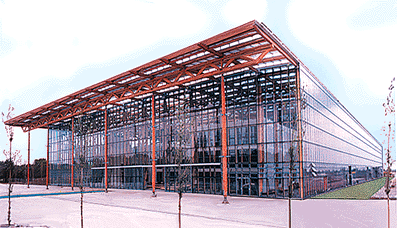 Academy Mont Cenis - visionary architecture on a former coal mine
The Mont Cenis coal mine was closed in 1978. The decision of the Northrhine-Westphalian Minister of the Interior to move the continuing training academy to Herne opened up the chance for a new technical masterpiece on "Mont-Cenis" at the end of the 80s. Starting from an urban planning seminar for the International Building Exhibition Emscher Park, it took just about ten years to complete a further symbol for the ecological and economic renewal of the region. A visionary architectural concept provides the impulse for the breakthrough to a new age: the neglected site of the old Mont Cenis mine in Herne has received a new face with a gigantic striking glass cover.
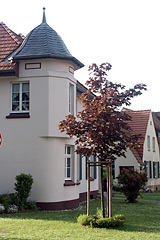 Teutoburgia - the miners` garden city
The housing settlement "Teutoburgia" was built in the years 1909 - 1923 for the miners of the Teutoburgia coal mine in the city of Herne. The ensemble includes a total of 136 buildings and is inspired by the ideal of the garden city: a "rural" idyll with nicely shaped green open space for the workers and employees of the coal mine. The admission as IBA project in 1989 lead to a comprehensive renewal of the housing development, preserving its unique character as "miners` garden city".
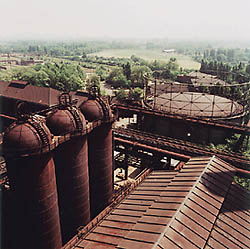 Duisburg-Nord Landscape-Park - a blast furnace to climb on
Located between the urban districts Hamborn and Meiderich, the Landscape Parc Duisburg covers 200 hectares. A former industrial site, the area is dominated by the disused Thyssen steelworks, which by itself covers 20 hectares. The juxtaposition of intensely designed areas with spaces or buildings left largely unaltered has made the park a major attraction from the outset. The park offers recreational facilities, such as a diving-pool in a disused gasometer, as well as sites of both historic and cultural interest.
The transformation of the steelworks is a result of a competition-winning design, by Peter and Anna-Liese Latz, influenced by deconstructionist philosophy. The binary pairs of park:waste, process:product and art:nature are inverted. Each privileged term is upset: waste becomes park, product becomes process, nature becomes art. Three types of recycling underlie the park design. First, buildings are re-cycled. Blast furnaces become accessible 'follies'; concrete tanks become walled gardens; water tanks become water gardens. Second, soil-forming materials are recycled. Third, water is recycled.
The park has been developed largely to encourage economic growth in the surrounding region. It is also the first "green stepping stone" of an even larger project: to clean and "green" the River Emscher, of which the landscape park forms a part. The river's misuse and subsequent toxicity, now being reversed, have shown how nature's principles are best at maintaining the purity of ecological resources such as water.
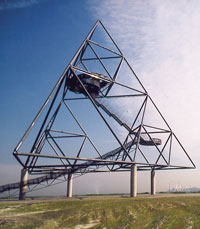 The Tetrahedron - great panorama view on the Ruhr area
Made of steel tubes and twisted castings, the tetrahedron symbolises the region's steel-girder construction culture as well as the structural change of the Ruhr area. The whole construct, conceived by the architect Wolfgang Chirst, is around 50 metres tall, topping the 65 metre-high spoil heap at the Beckstraße in Bottrop. Randomly constructed steps and a viewing platform make the sculpture accessible. The stairs and the platforms offer a unique view of the interior of the tower, the surface of the dump and a panoramic view of the cityscape along the Emscher.
Copyright © 2000 - 2002 by 42nd ERSA Congress Dortmund 2002 |
Generated 08/08/2002 |